Home / Articles / 5-AXIS CNC MACHINING

5-AXIS CNC MACHINING


Learn how 5-axis CNC machining works, when to use it vs 3-axis or 3+2, real cost comparisons, and which materials benefit most. Engineer-written guide from FlagShip.


Author Picture Ethan Published Date: 2026/4/13
5-AXIS CNC MACHINING

5-Axis CNC Machining: What It Is, How It Works, and When You Actually Need It


5-axis CNC machining moves a cutting tool along three linear axes (X, Y, Z) and two rotational axes (A and B) simultaneously. It machines complex parts in a single setup, cutting setup time by 60-80% compared to 3-axis work. But it costs 2-3x more per hour. You need it for undercuts, compound curves, and multi-face features. For simple prismatic parts, 3-axis is faster and cheaper.

Most engineers don't need 5-axis CNC machining. That's not a popular thing to say on a manufacturing blog, but it's true. A well-programmed 3-axis mill handles 70-80% of production work at lower hourly rates. The problem is knowing where that line sits for your specific part.

5-axis CNC machining becomes the clear choice when your geometry demands tool access from multiple angles in a single clamping. Turbine blades, impellers, orthopedic implants, complex aerospace brackets: these parts either require 5-axis or they require so many setups on a 3-axis machine that the total cost exceeds 5-axis anyway.

This guide breaks down exactly how 5-axis works, what the real cost differences look like, which materials and geometries benefit most, and (just as important) when to skip it entirely. No marketing language. Just the engineering math.

What Is 5-Axis CNC Machining?

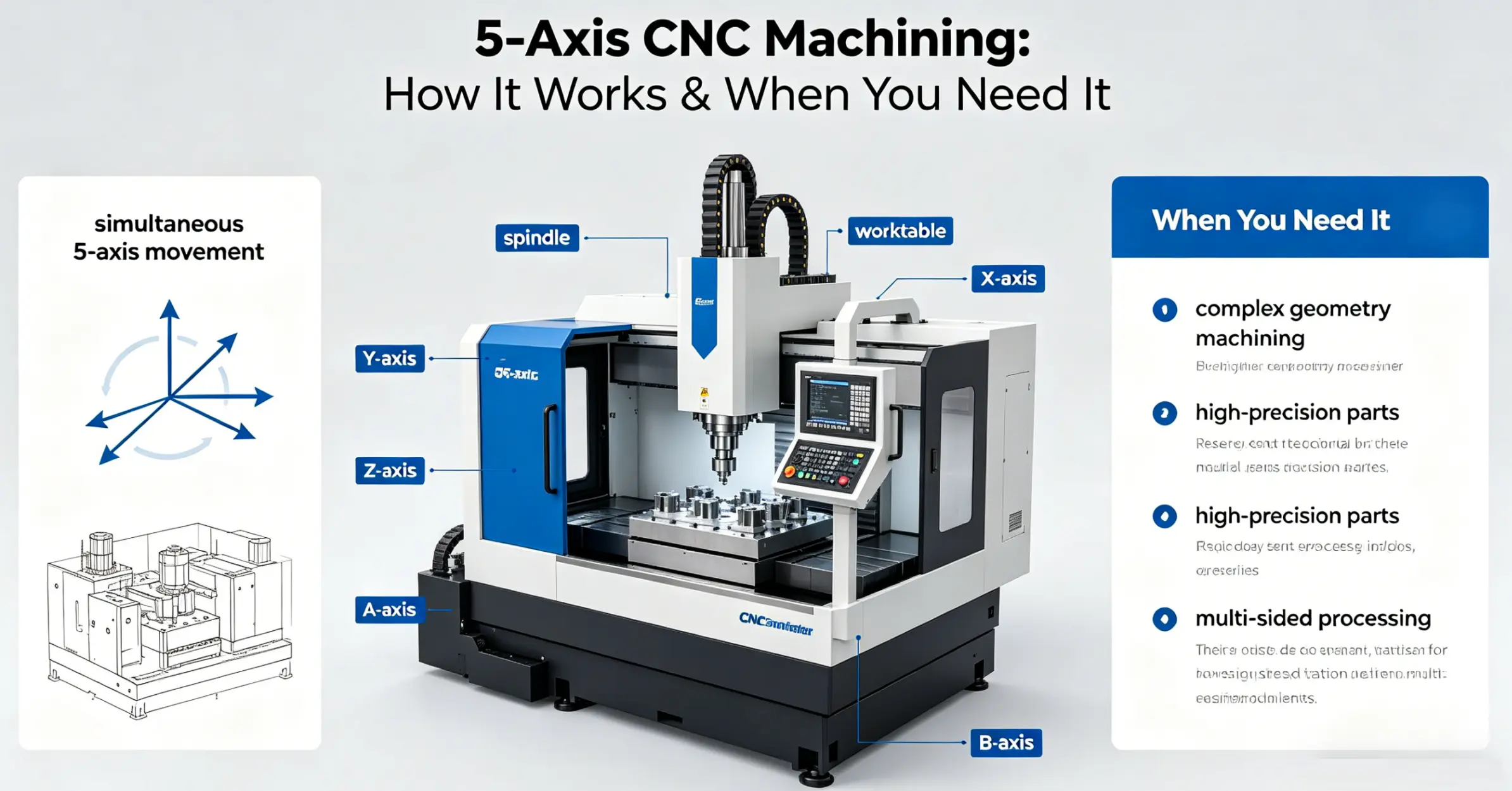
A 5-axis CNC machine moves a cutting tool along five distinct axes of motion at the same time. Three of those are the standard linear axes you already know: X (left-right), Y (forward-back), and Z (up-down). The other two are rotational. Depending on the machine configuration, those rotational axes are typically A (rotation around X) and B (rotation around Y), though some machines use a B and C combination instead.

The practical result? The cutting tool can approach the workpiece from virtually any angle without the operator stopping the machine to re-clamp or reposition the part. A feature on the top face, a pocket on the side, an angled hole at 37 degrees, all machined in one setup.

That single-setup capability is where the real value lives. Every time you unclamp a part and re-fixture it on a 3-axis machine, you introduce positional error. Even with precision vises and dowel pins, you're looking at ±0.001-0.003 in. of re-fixturing error per setup. On a part that needs four setups, those errors stack. On a 5-axis machine, the coordinate system stays locked from first cut to last.


How Does 5-Axis Differ from 3-Axis and 3+2 Machining?


Standard 3-axis CNC machining moves the tool in X, Y, and Z only. The tool always points straight down (or at whatever fixed angle the spindle sits). To machine a feature on the side of a part, you stop, unclamp, rotate the part 90 degrees, re-indicate, and resume cutting. Each setup adds 15-45 minutes of non-cutting time.

3+2 machining (also called indexed 5-axis or positional 5-axis) is the middle ground. The machine has two rotational axes, but they don't move during cutting. Instead, the rotational axes position the part at a specific angle, lock in place, and then the three linear axes do the cutting. Think of it as automated re-fixturing. The machine tilts the part to 37 degrees, locks, and mills with X, Y, Z. Then it tilts to 52 degrees, locks again, and mills the next feature.

Simultaneous 5-axis machining is the full capability. All five axes move at the same time during cutting. The tool follows a continuous, sculpted path while the part tilts and rotates beneath it. This is what you need for compound curves, freeform surfaces, and contoured geometry like turbine blades or impeller vanes.

Here's a practical cost comparison:

• 3-axis: $75-150/hr machine rate. Simple parts. Multiple setups required for multi-face features.

• 3+2 (indexed 5-axis): $125-200/hr. Multi-face prismatic parts in one clamping. No continuous contouring.

• Simultaneous 5-axis: $150-300/hr. Complex freeform geometry. Single setup. Shortest cycle time for complex parts.

The hourly rate for 5-axis is higher. But the total part cost often comes out lower for complex geometry because you eliminate 3-4 setups worth of handling time, inspection time, and scrap risk.

What Parts Actually Need 5-Axis CNC Machining?

Not every complex-looking part needs simultaneous 5-axis. Here's how to decide.

You need 5-axis for:

• Undercuts and features the tool physically cannot reach from a top-down approach

Compound curves and sculpted surfaces (airfoils, impeller blades, organic medical implant geometry)

• Deep cavities where shorter, more rigid tools at an angle outperform long tools pointing straight down

• Parts with tight GD&T callouts across multiple faces (true position within 0.002 in. between features on different sides)

3+2 is usually enough for:

• Multi-face prismatic parts (housings, brackets, manifolds) where every feature is flat or cylindrical

• Angled holes and pockets at known, fixed angles

• Parts that would need 3-4 setups on a 3-axis mill

Stick with 3-axis for:

• Flat parts machined from one side (covers, plates, simple brackets)

• Turned parts with basic milling features (cross-holes, flats)

• High-volume production where dedicated fixtures on a 3-axis VMC beat the hourly rate of a 5-axis

The mistake engineers make most often? Specifying 5-axis capability for a part that 3+2 handles perfectly. The geometry doesn't require continuous tool movement, but the drawing gets routed to a 5-axis machine anyway, and the shop charges 5-axis rates. Confirm with your supplier whether your part actually needs simultaneous motion or just multi-face access.


Which Materials Benefit Most from 5-Axis?

5-axis machining provides the biggest advantage on materials that are difficult to machine or expensive to scrap.

Titanium alloys (Ti-6Al-4V, Grade 2): Titanium work-hardens rapidly if the tool dwells or rubs instead of cutting cleanly. On a 3-axis machine with long tool extensions reaching into deep pockets, deflection causes rubbing. The material hardens in that zone, and the next pass cuts even worse. 5-axis lets you use shorter, more rigid tools at the optimal cutting angle, keeping chip load consistent. That alone can extend tool life 40-60% on titanium machining jobs.

Aluminum alloys (6061-T6, 7075-T6): Aluminum is forgiving to machine, so the 5-axis benefit here is speed, not survivability. A 5-axis machine can maintain a constant chip thickness on sculpted surfaces, which means higher feed rates (often 2-3x faster than a 3-axis approach) and better surface finish. For large aluminum aerospace structural parts, cycle time reduction is significant.

Stainless steel (304, 316L, 17-4 PH): Similar to titanium, stainless responds poorly to tool rubbing and inconsistent chip load. 5-axis approach angles keep cutting forces more predictable, which matters for thin-walled features where deflection causes chatter marks.

PEEK and engineering plastics: Plastics seem easy, but they're thermally sensitive. A tool that dwells too long melts the surface rather than cutting it. 5-axis contouring moves the tool smoothly without sudden direction changes, producing cleaner edges on PEEK and polycarbonate parts.

One caveat: for simple steel or brass parts (SAE 1018, C360 free-cutting brass), 5-axis adds cost without meaningful quality improvement. These materials machine easily in any configuration. Put them on a 3-axis mill and save money.

What Tolerances Can 5-Axis Achieve?

5-axis CNC machines can hold ±0.0005 in. (±0.013 mm) on critical dimensions when properly calibrated. Standard tolerance for most 5-axis work is ±0.002 in. (±0.05 mm), which is tighter than typical 3-axis work (±0.005 in.) largely because of the single-setup advantage.

The real tolerance gain isn't just about the machine's resolution. It's about error stacking.

Consider a housing with a bore on the top face that must align with a bore on the side face within 0.003 in. true position. On a 3-axis machine, you machine the top bore in setup 1, flip the part, indicate, and machine the side bore in setup 2. Each setup introduces its own positional error. You might hold ±0.001 in. per setup, but the relationship between the two features absorbs both errors.

On a 5-axis machine, both bores are machined in one clamping. The coordinate system doesn't shift. The positional relationship between those two features is limited only by the machine's volumetric accuracy, not by re-fixturing tolerances.

For parts with GD&T callouts across multiple datum planes (common in aerospace and medical components), this is the difference between passing inspection on the first article and needing multiple rounds of adjustment.

Surface finish on 5-axis work typically achieves Ra 0.4-1.6 µm (16-63 µin.), with Ra 0.8 µm being standard for semi-finish passes. If your surface finish requirement is Ra 0.4 µm or better, plan for a finishing pass with a ball-nose end mill at high RPM and low step-over (0.1-0.2 mm).

Industries That Rely on 5-Axis Machining

Aerospace and defense: Structural brackets, bulkhead fittings, turbine blades, actuator housings, and landing gear components. AS9100D certification is typically required. Most aerospace parts have features on 3-5 faces with tight inter-feature tolerances, making single-setup 5-axis the default approach.

Medical devices: Orthopedic implants (hip cups, spinal cages), surgical instruments, and diagnostic equipment housings. Biocompatible materials like Ti-6Al-4V and PEEK require the controlled cutting conditions 5-axis provides. ISO 13485 traceability from billet to finished part.

Automotive (performance and EV): Turbocharger housings, intake manifolds, lightweight suspension knuckles, and EV motor housings in 6061-T6 or A356 cast aluminum. 5-axis enables aggressive material removal strategies that cut cycle times on high-value components.

Robotics and automation: Servo motor housings, actuator brackets, and multi-feature structural joints. Robotics parts often combine precise bore patterns with complex external geometry, which is the textbook 5-axis use case.

How to Get 5-Axis Parts Quoted and Produced

Getting an accurate quote for 5-axis work requires more than just uploading a STEP file. Here's what speeds up the process and avoids surprises:

1. Include a 2D drawing with GD&T. The 3D model defines geometry, but the drawing defines tolerances, datums, and surface finish requirements. Without it, the shop has to guess which dimensions are critical, and they'll either over-machine (costing you money) or under-machine (costing you scrap).

2. Specify your material with the full alloy and temper. "Aluminum" gets you a question. "6061-T6 per AMS-QQ-A-250/11" gets you a price. The alloy grade affects tool selection, feed rates, and cycle time, all of which directly affect cost.

3. Call out critical features. If only 3 dimensions on a 40-dimension part need ±0.001 in., say so. Applying tight tolerance blanket-style across the entire drawing inflates cost 30-50% unnecessarily.

4. Ask whether your part actually needs simultaneous 5-axis or if 3+2 is sufficient. A good supplier will tell you. If they don't, ask. The hourly rate difference is real.

FlagShip's CNC machining services include 5-axis milling with tolerances to ±0.0001 in. on precision features. Upload your CAD file to get DFM feedback and an instant quote. If your part is better suited to 3+2 or even 3-axis, the engineering review will flag that and price accordingly, so you're never paying for capability you don't need.

What does 5-axis CNC machining mean?

5-axis CNC machining means the cutting tool and workpiece move along five axes simultaneously: three linear (X, Y, Z) and two rotational (typically A and B). This allows the tool to approach the part from virtually any angle in a single setup, eliminating the need for multiple re-clampings that introduce positional error.

Is 5-axis CNC machining more expensive than 3-axis?

Yes, the hourly machine rate is typically 2-3x higher ($150-300/hr vs. $75-150/hr). But for complex parts needing 3+ setups on a 3-axis machine, total part cost on a 5-axis is often lower because you eliminate setup time, reduce scrap risk, and achieve tighter inter-feature tolerances in one clamping.

What is the difference between 3+2 and simultaneous 5-axis?

In 3+2 machining, the two rotational axes position the part at a fixed angle, lock, and cutting happens in 3 axes only. In simultaneous 5-axis, all five axes move during cutting. Use 3+2 for multi-face prismatic features; use simultaneous 5-axis for compound curves, sculpted surfaces, and continuous freeform geometry.

What materials are best suited for 5-axis machining?

Titanium alloys (Ti-6Al-4V), aluminum alloys (7075-T6, 6061-T6), stainless steels (304, 316L, 17-4 PH), Inconel, and engineering plastics like PEEK benefit most. These materials either work-harden under improper cutting conditions or require consistent chip load that 5-axis tool angles maintain better than 3-axis long-reach tools.

What tolerances can 5-axis CNC machines hold?

Standard 5-axis tolerance is ±0.002 in. (±0.05 mm). Precision work achieves ±0.0005 in. (±0.013 mm) on critical features. The main advantage over 3-axis isn't tighter machine resolution; it's eliminating re-fixturing error that stacks when you machine multiple faces in separate setups.

When should I NOT use 5-axis CNC machining?

Skip 5-axis for simple flat parts machined from one side, basic turned parts with minimal milling, high-volume production runs where dedicated 3-axis fixtures are cheaper per unit, and easy-to-machine materials (mild steel, free-cutting brass) where the geometry doesn't demand multi-angle tool access. Paying 5-axis rates for a part that runs fine on a VMC is a common and avoidable waste.

How long does it take to get 5-axis CNC parts?

Lead times vary by complexity. Simple 5-axis parts (3-5 features across multiple faces) ship in 5-7 business days. Complex aerospace or medical components with tight tolerances and inspection requirements typically take 10-15 business days. Expedited 1-3 day service is available for prototype quantities.

Do I need to provide a 2D drawing for 5-axis CNC quoting?

Not always, but it significantly improves quote accuracy. The 3D STEP file defines geometry, but a 2D drawing with GD&T callouts tells the shop which dimensions are critical, what surface finishes are required, and where tolerances are tight. Without it, shops either over-price to cover risk or under-spec and produce parts that don't pass inspection.