{"@context":"https://schema.org","@type":"BreadcrumbList","itemListElement":[{"@type":"ListItem","position":1,"name":"Home","item":"https://fsproto.com"},{"@type":"ListItem","position":2,"name":"Blog","item":"https://fsproto.com/blog/Articles/"},{"@type":"ListItem","position":3,"name":" Medical CNC Machining: Materials, Tolerances & ISO 13485","item":"https://fsproto.com/blog/Articles/MEDICAL-CNC-MACHINING/"}]}
Home / Articles / Medical CNC Machining: Materials, Tolerances & ISO 13485
Medical CNC Machining: Materials, Tolerances & ISO 13485
Medical CNC machining guide: biocompatible materials (Ti-6Al-4V, 316L, PEEK), tolerance tiers by application, ISO 13485 requirements, and the prototype-to-production regulatory pathway.
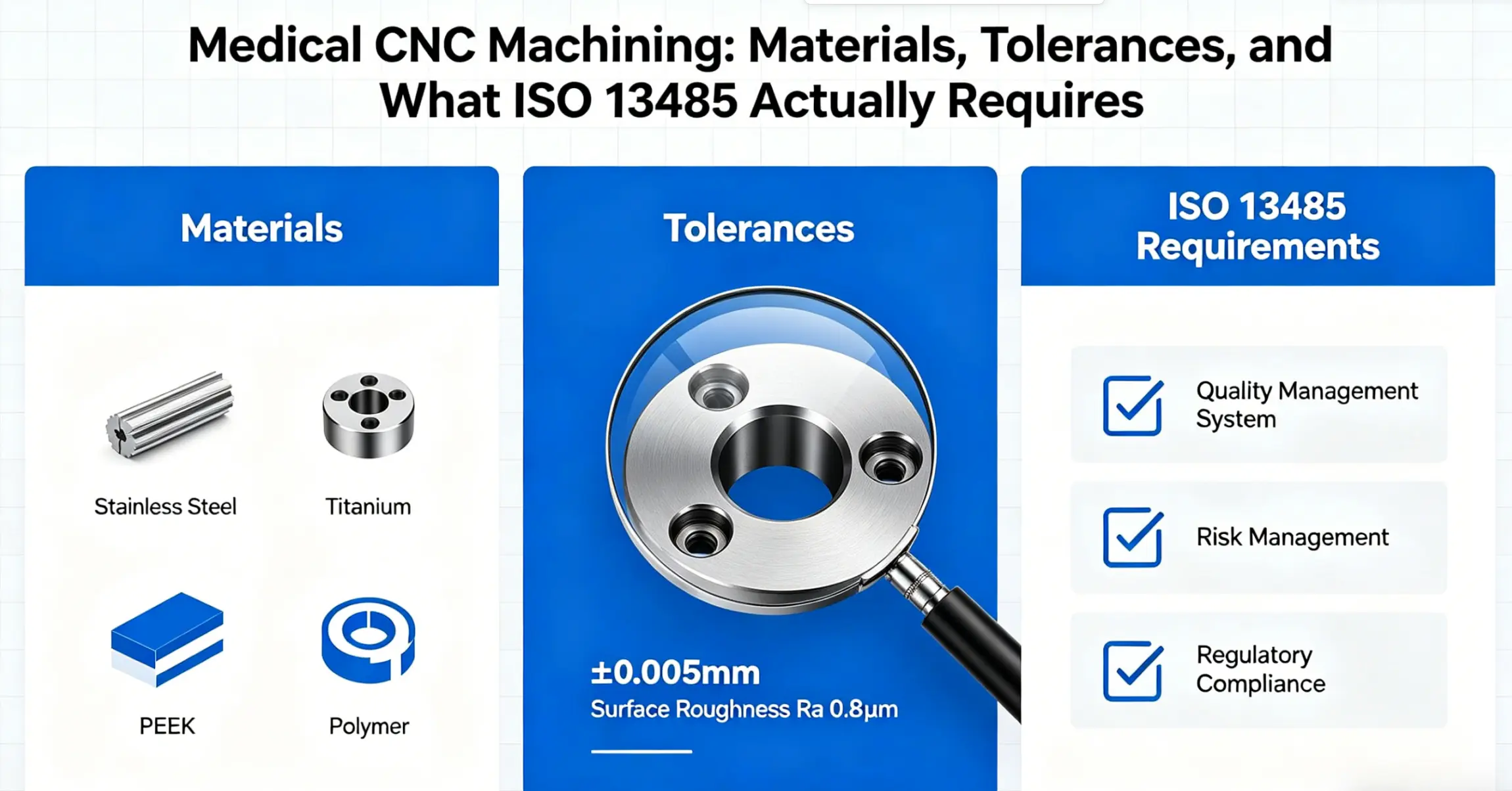
Medical CNC Machining: Materials, Tolerances, and What ISO 13485 Actually Requires
Medical CNC machining produces implants, surgical instruments, and diagnostic device components to tolerances of ±0.0005 in. or tighter using biocompatible materials like Ti-6Al-4V, 316L stainless steel, and PEEK. ISO 13485 certification isn't optional; it governs traceability from raw material to finished part. The biggest cost driver isn't the machining itself but the documentation, validation, and inspection trail the regulatory pathway demands.
A titanium spinal cage that's 0.002 in. out of spec doesn't just fail inspection. It fails inside a patient. That's the difference between medical CNC machining and every other kind of precision work: the tolerance on the drawing isn't a manufacturing preference, it's a clinical requirement.
Medical CNC machining covers everything from orthopedic implants (hip cups, spinal interbody cages, bone plates) to surgical instruments (forceps, retractors, drill guides) to diagnostic equipment housings (MRI components, CT scanner brackets, ultrasound transducer assemblies). The materials are biocompatible, the tolerances are tight, and the documentation trail follows the part from billet to sterilized package.
What most guides skip is the regulatory side. It's not enough to hold ±0.0005 in. on a bore diameter. You need to prove you held it, trace which material lot produced it, document which machine cut it, and file that data in a Device History Record (DHR) that an FDA auditor can pull five years later. That traceability system is what separates a medical machining supplier from a general-purpose CNC shop with tight tolerances.
What Makes Medical CNC Machining Different from Standard Precision Work?
The machining itself uses the same equipment: CNC milling centers, CNC turning lathes, Swiss-type machines, wire EDM, and 5-axis machining centers. The toolpaths, feeds, and speeds are similar to aerospace work. So what's different?
Three things: material traceability, process validation, and documentation depth.
Material traceability means every billet has a Material Test Report (MTR) that traces back to the mill heat lot. If you're machining Ti-6Al-4V per ASTM F136 (the medical-grade titanium spec), the MTR proves the alloy chemistry falls within spec limits. The MTR follows the part through every operation. If a batch of implants fails in the field, the manufacturer traces back to the raw material lot, the machine that cut the parts, the operator who ran them, and the inspection data that cleared them. This isn't theoretical; it's an FDA expectation.
Process validation means proving that your machining process consistently produces parts within tolerance before you ship production units. For a new implant geometry, you typically run an IQ/OQ/PQ sequence (Installation Qualification, Operational Qualification, Performance Qualification). In practice, that means machining 30-50 parts, measuring every critical dimension on every part, and demonstrating Cpk above 1.33 on all critical features. Only after that validation clears do production runs begin.
Documentation depth means every operation generates a record. Setup sheets, in-process measurements, CMM reports, surface finish readings, passivation certificates, sterilization validation records. A single implant might generate 15-20 pages of documentation. That's the real cost adder in medical work: not the cutting, but the paper (or the digital equivalent in an eQMS).
Which Materials Are Used in Medical CNC Machining?
Material selection in medical machining is driven by three questions: Is it biocompatible? Can it withstand sterilization cycles? Does it have the mechanical properties the application demands?
Titanium Grade 5 (Ti-6Al-4V per ASTM F136)
The workhorse material for load-bearing implants. Titanium Grade 5 has a tensile strength of 130 ksi, excellent corrosion resistance in body fluids, and is non-magnetic (MRI compatible). It's the default choice for hip stems, spinal interbody cages, bone plates, and dental implant abutments.
Machining consideration: Ti-6Al-4V work-hardens rapidly. If the tool rubs instead of cutting cleanly (common with worn inserts or incorrect feeds), the surface hardens and the next pass cuts even worse. Use sharp carbide inserts, maintain chip load above 0.003 in./tooth, and apply high-pressure coolant (1,000+ psi) directed at the cutting zone. Tool life on titanium is typically 15-25 minutes per edge, compared to 45-60 minutes on aluminum.
Stainless Steel 316L (per ASTM F138)
The standard for surgical instruments, temporary implants, and non-load-bearing components. 316L stainless has excellent corrosion resistance and is easier to machine than titanium, but it's heavier (density 8.0 g/cm³ vs titanium's 4.43 g/cm³). Passivation per ASTM A967 is required after machining to restore the chromium oxide layer that cutting disrupts.
The "L" in 316L matters: it designates low carbon content (0.03% max), which reduces susceptibility to intergranular corrosion after welding or heat exposure. Don't substitute standard 316 for 316L on a medical drawing; the specs are not interchangeable.
PEEK (Polyetheretherketone, per ASTM F2026)
PEEK is the go-to polymer for spinal fusion cages, dental healing abutments, and any application that needs radiolucency (transparent to X-ray, so surgeons can see bone growth through the implant on follow-up imaging). Implant-grade PEEK (Zeniva, Invibio PEEK-OPTIMA) carries USP Class VI biocompatibility certification.
Machining caveat: PEEK is moisture-sensitive before machining. If the rod stock sits in a humid environment, absorbed moisture can cause micro-voids during aggressive cutting. Dry PEEK at 300°F (150°C) for 3-4 hours before machining for best results. Use sharp, uncoated carbide tools and avoid coolant if possible; PEEK can absorb cutting fluid and discolor.
Cobalt-Chrome (CoCr, per ASTM F75/F1537)
Used for hip femoral heads, knee condylar components, and dental frameworks. Extremely hard (35-45 HRC), which gives excellent wear resistance in articulating joints but makes it one of the most difficult medical alloys to machine. Expect tool life 50-70% shorter than on titanium. Carbide with AlTiN coating at moderate speeds (60-100 SFM) is the standard approach.
What Tolerances Does Medical CNC Machining Require?
Medical tolerances depend entirely on the application. Not every medical part needs ultra-tight specs.
Implant mating surfaces (press-fit or articulating): ±0.0005 in. (±0.013 mm) or tighter. A hip cup and femoral head that articulate against each other need concentricity within 0.001 in. and surface finish below Ra 0.1 µm (mirror polish) on the bearing surfaces. These are typically ground and polished after initial CNC machining.
Bone screws and fixation hardware: ±0.001-0.002 in. (±0.025-0.05 mm) on thread major diameter and pitch. Swiss CNC turning handles these efficiently. Thread profiles are verified with thread gauges and optical comparators.
Surgical instruments (forceps, retractors, rongeurs): ±0.002-0.005 in. on most features. The critical tolerance is usually at the pivot point (the pin hole that allows the instrument to open and close). That bore needs ±0.0005 in. to prevent lateral play that degrades the surgeon's feel.
Diagnostic equipment housings and brackets: ±0.005 in. standard. These parts don't contact patients directly, so general CNC machining tolerances apply. The exception is MRI bore components, which require non-magnetic materials and tight concentricity.
A common over-engineering mistake: specifying ±0.0005 in. across an entire surgical instrument drawing when only the pivot bore needs it. That blanket tolerance can inflate machining cost 40-60% compared to calling out the tight spec only where function demands it.
What Does ISO 13485 Actually Require for CNC Machining?
ISO 13485 is the quality management system standard for medical device manufacturing. If your machining supplier isn't ISO 13485 certified, your parts cannot legally be used in a device submitted to the FDA under a 510(k) or PMA pathway without significant additional qualification work.
Here's what ISO 13485 actually requires in the machining context:
Design and Development Controls (Clause 7.3): If the machining supplier contributes to design (for example, recommending a material change or a tolerance adjustment for manufacturability), that design input must be documented and traceable.
Purchasing Controls (Clause 7.4): Every raw material supplier must be qualified. The titanium bar stock vendor, the cutting tool supplier, and the calibration service provider all need documented evaluations. This is why medical machining suppliers can't just buy material from any distributor; the supply chain is locked down.
Production and Service Provision (Clause 7.5): Validated processes, documented work instructions, and in-process monitoring. If a CNC program is changed, the change must go through a formal change control process before production resumes.
Monitoring and Measurement (Clause 7.6): All measurement equipment (CMMs, micrometers, gauges) must be calibrated on schedule with records maintained. If a caliper is one day past its calibration due date, any measurement taken with it is technically invalid.
Traceability (Clause 7.5.3): Every part must be traceable to raw material lot, machining date, operator, machine, inspection data, and shipping record. This is the non-negotiable core of medical manufacturing.
FlagShip holds ISO 13485 certification, which means these controls are built into the production workflow, not bolted on as an afterthought.
How Does a Medical Part Go from Prototype to Production?
The regulatory pathway for a medical device shapes the manufacturing timeline. Unlike aerospace (where a part goes from prototype to production in weeks), medical devices follow a phased approach that can take 6-24 months depending on the device classification.
Phase 1: Design Prototyping (2-4 weeks)
Engineers iterate on geometry, material, and features. CNC prototyping produces 5-20 units for bench testing, fit checks, and design reviews. At this stage, general-purpose CNC shops can handle the work; ISO 13485 isn't required for prototypes that won't be used clinically.
Phase 2: Design Verification and Validation (4-12 weeks)
V&V testing requires parts made under controlled conditions. This is where ISO 13485 machining begins. The parts used in biocompatibility testing (per ISO 10993), mechanical testing (fatigue, static load, corrosion), and simulated-use testing must come from a validated process.
Phase 3: Design Transfer (2-4 weeks)
The design is "transferred" to production. This means locking down the CNC program, fixturing, inspection plan, and work instructions. The IQ/OQ/PQ validation runs happen here (typically 30-50 parts measured on every critical dimension).
Phase 4: Regulatory Submission
For a 510(k) device, the submission includes manufacturing process descriptions and validation data. The FDA reviewer can (and does) ask for specifics about machining processes, material sourcing, and inspection methods. Having a qualified ISO 13485 supplier at this stage avoids costly delays.
Phase 5: Production (ongoing)
Validated process runs production volumes. Any change to the CNC program, material supplier, tooling, or fixturing triggers a change control review and potentially a partial revalidation.
FlagShip supports all five phases through its CNC machining services, from initial prototyping (1-3 day lead time) through validated production runs with full DHR documentation.
What Surface Finishes Are Required for Medical Parts?
Surface finish on medical parts isn't just cosmetic. It directly affects biocompatibility, bacterial adhesion, and fatigue life.
Implant bearing surfaces (hip cups, knee condyles): Ra 0.025-0.05 µm (1-2 µin.). Achieved by grinding and polishing after CNC machining. This mirror finish reduces friction in articulating joints and minimizes wear particle generation.
Implant non-bearing surfaces (bone-contacting faces): Ra 1.0-3.2 µm (40-125 µin.) or intentionally roughened. Some implant designs use bead-blasted or plasma-sprayed surfaces to promote bone ingrowth (osseointegration). The rough texture gives osteoblasts something to grab onto.
Surgical instruments: Ra 0.4-0.8 µm (16-32 µin.) on functional surfaces. Electropolishing is common for stainless steel instruments; it removes the outermost metal layer (approximately 0.0001-0.0005 in.), creating a smooth, passive surface that resists corrosion and is easier to sterilize.
Passivation is required for all stainless steel medical parts per ASTM A967 or AMS 2700. The citric acid or nitric acid bath removes free iron from the surface and restores the chromium oxide passive layer. Without passivation, stainless steel instruments develop surface rust spots within weeks (called "rouge" in the medical industry), which is an automatic rejection in any hospital's receiving inspection.
Explore the full range of surface finishing options available for medical CNC machined parts.
Frequently Asked Questions
What is medical CNC machining?
Medical CNC machining is the production of medical device components, implants, and surgical instruments using computer-controlled cutting tools. It differs from general CNC machining in its material traceability requirements, process validation protocols, and documentation depth governed by ISO 13485 and FDA regulations. Parts are machined from biocompatible materials (titanium, 316L stainless, PEEK, cobalt-chrome) to tolerances of ±0.0005 in. or tighter.
What certifications should a medical CNC machining supplier have?
At minimum, ISO 13485 (medical device quality management) and ISO 9001 (general quality). For defense-related medical devices, ITAR registration may be required. FDA registration as a contract manufacturer is also relevant for suppliers producing components for devices under 510(k) or PMA submissions. FlagShip holds ISO 13485, ISO 9001, and IATF 16949 certifications.
What materials are most commonly used for medical CNC machining?
Titanium Grade 5 (Ti-6Al-4V per ASTM F136) for load-bearing implants, 316L stainless steel (per ASTM F138) for surgical instruments, PEEK (per ASTM F2026) for radiolucent spinal cages and dental components, and cobalt-chrome (per ASTM F75) for articulating joint surfaces. Each material has a corresponding ASTM standard that defines its chemistry and mechanical property requirements.
How tight are tolerances for medical CNC machined parts?
It depends on the application. Implant bearing surfaces require ±0.0005 in. or tighter with mirror-polish finishes (Ra 0.05 µm). Bone screws need ±0.001-0.002 in. on thread dimensions. Surgical instruments typically need ±0.002-0.005 in. except at pivot points (±0.0005 in.). Diagnostic device housings use standard ±0.005 in. tolerances.
What is the cost difference between medical and standard CNC machining?
Medical CNC machining typically costs 30-60% more than equivalent standard precision work. The machining itself is similar in cost; the premium comes from material traceability documentation, process validation (IQ/OQ/PQ), in-process and final CMM inspection with formal reports, passivation or electropolishing, and the overhead of maintaining an ISO 13485 quality system.
Can medical CNC parts be prototyped before production validation?
Yes. Design prototypes for bench testing and fit checks can be machined without ISO 13485 controls. However, any parts used in biocompatibility testing, mechanical testing, or clinical evaluations must be produced under ISO 13485 conditions with full traceability. Plan for this transition early; switching from a prototype shop to a validated production supplier mid-program adds weeks.
What is a Device History Record (DHR) in medical machining?
A DHR is a complete record of a specific production lot. It includes the material certificate (MTR with heat lot), CNC setup documentation, in-process inspection data, final CMM report, surface finish measurements, passivation or finishing certificates, operator identification, and shipping records. FDA auditors can request any DHR at any time, and the manufacturer must produce it within a reasonable timeframe.
How long does it take to go from prototype to production for a medical CNC part?
Prototyping takes 1-3 weeks. Design verification and validation testing typically requires 4-12 weeks depending on test complexity. Design transfer and process validation (IQ/OQ/PQ) adds another 2-4 weeks. Total timeline from first prototype to validated production capability is typically 3-6 months for a Class II medical device. Class III devices (implants) can take 12-24 months due to additional clinical evidence requirements.
 Penny Pan
Published Date: 2026/4/24
Penny Pan
Published Date: 2026/4/24