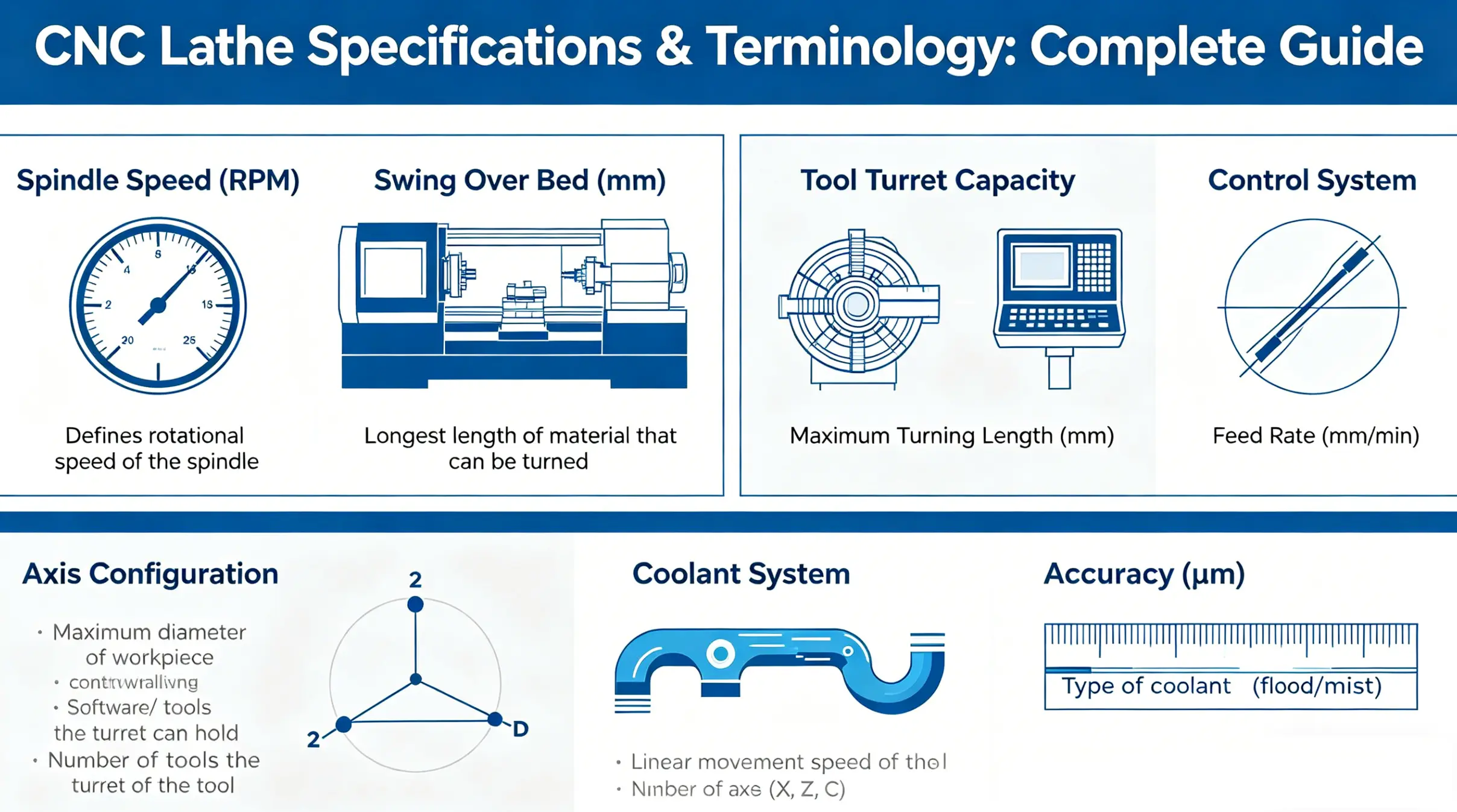
Every CNC lathe spec explained: swing over bed vs carriage, spindle bore, distance between centers, live tooling, Swiss-type, turret stations. Engineer reference guide. (160 chars) H1: CNC Lathe Technical Specifications and Terminology: What Every Spec Means for Your Parts
CNC Lathe Technical Specifications and Terminology: What Every Spec Means for Your Parts
TL;DR: CNC lathe specifications determine what parts the machine can produce. Swing over bed (max workpiece diameter), distance between centers (max length), spindle bore (max bar stock diameter), and spindle speed range (RPM for different materials) are the four specs that define a lathe's capability envelope. Understanding these specs helps you communicate requirements to your machining supplier, evaluate whether a shop can handle your parts, and avoid quoting delays caused by spec mismatches. This guide translates every major CNC lathe spec into practical meaning for part design and ordering.
Engineers who design parts on CNC mills every day often freeze when they encounter a CNC lathe spec sheet. Swing over bed, swing over carriage, spindle bore, distance between centers, turret stations, live tooling capability: the terminology isn't intuitive if you haven't spent time around turning operations.
But understanding CNC lathe technical specifications matters even if you never operate a lathe yourself. When you send a turned part drawing to a CNC turning supplier, the supplier matches your part dimensions against their machine specs. If your shaft is 14 inches in diameter and their lathe has a 12-inch swing over carriage, they can't make it. If your bar stock is 3 inches in diameter and their spindle bore is 2.5 inches, they can't feed it through the spindle for high-production bar work.
This guide translates every major CNC lathe specification into what it means for your parts: what it limits, what it enables, and what to check before sending a turning job to quote.
What Is Swing Over Bed (and Why Are There Three Swing Specs)?
Swing over bed is the maximum diameter of a workpiece that can rotate over the lathe bed without hitting it. It's measured as twice the distance from the spindle centerline to the nearest point on the bed surface.
But a CNC lathe spec sheet typically lists three swing measurements, and they mean different things:
Specification
What It Measures
What It Limits
Typical Range
Swing over bed
Max diameter that clears the bed ways
Largest raw stock that physically fits on the machine
10-40 in. (250-1,000 mm)
Swing over carriage (cross slide)
Max diameter that clears the carriage when it's positioned under the workpiece
Largest diameter you can actually turn (tool must reach the part)
60-80% of swing over bed
Swing over gap (if equipped)
Max diameter with the gap bridge removed
Largest diameter for facing or short turning near the chuck
10-30% larger than swing over bed
The critical distinction: swing over bed is the theoretical maximum. Swing over carriage is the practical maximum for most turning operations, because the carriage (which holds the cutting tool) sits higher than the bed surface and reduces the available clearance.
Example: a lathe with 20 in. swing over bed and 12 in. swing over carriage can hold a 20-inch diameter workpiece for facing operations close to the chuck, but can only turn (cut) diameters up to 12 inches when the carriage is in the working position. If your part is 14 inches in diameter and needs full-length turning, this lathe cannot produce it, even though 14 inches is less than the 20-inch swing.
When specifying parts for CNC turning, always compare your part OD against swing over carriage, not swing over bed.
What Is Distance Between Centers and Maximum Turning Length?
Distance between centers is the maximum distance between the headstock spindle face and the tailstock center. It defines the longest workpiece the lathe can accommodate when supported at both ends.
Maximum turning length is usually shorter than distance between centers because the chuck, toolholder, and tailstock quill each consume some of the available space. The practical turning length is typically 85-90% of the stated distance between centers.
Lathe Size Class
Distance Between Centers
Practical Max Turning Length
Typical Applications
Compact/bench
12-20 in. (300-500 mm)
10-17 in.
Small shafts, pins, fittings, connectors
Mid-size
20-40 in. (500-1,000 mm)
17-35 in.
Pump shafts, hydraulic cylinders, spindles
Full-size
40-80 in. (1,000-2,000 mm)
35-70 in.
Drive shafts, large rollers, long-bore components
Heavy-duty
80-200+ in. (2,000-5,000+ mm)
70-180+ in.
Mine shaft components, paper mill rollers, marine propeller shafts
Design implication: if your shaft is 45 inches long, you need a lathe with at least 50-55 inches between centers (adding margin for chuck and tailstock). A mid-size lathe with 40 inches between centers cannot produce your part. When quoting long shaft work, confirm the supplier's maximum turning length explicitly; don't assume it equals their published center distance.
What Does Spindle Bore Size Mean for Your Parts?
Spindle bore is the diameter of the hole through the center of the lathe spindle. It determines the maximum diameter of bar stock that can be fed through the spindle for bar-fed (collet chuck or bar feeder) production.
This spec matters enormously for production turning. When a shop runs bar stock through the spindle, they can load a 6-12 foot bar, machine a part from the end, cut it off, advance the bar, and repeat without stopping to load individual billets. This is how high-volume turned parts (pins, bushings, fittings, shafts under 3 inches diameter) are produced efficiently.
Common spindle bore sizes:
Small CNC lathes: 1.5-2.0 in. (38-51 mm) bore
Mid-size CNC lathes: 2.5-3.5 in. (63-89 mm) bore
Large CNC lathes: 4.0-6.0 in. (102-152 mm) bore
Swiss-type CNC lathes: 0.5-1.25 in. (12-32 mm) bore (designed for small-diameter precision work)
If your part is a 2.5-inch diameter shaft produced from bar stock, the shop needs a lathe with at least a 2.6-inch spindle bore (0.1 in. clearance minimum). If the bore is too small, they must cut individual billets and load each one manually into a chuck, which adds 30-60 seconds of non-cutting time per part. On a 500-piece run, that's 4-8 hours of additional labor.
What Do Spindle Speed and Power Specs Mean?
Spindle speed (RPM) and spindle motor power (HP or kW) determine which materials can be cut and how aggressively.
Spindle speed is specified as a range (e.g., 50-4,500 RPM). The required RPM depends on the surface speed (SFM) for the material and the diameter being cut:
RPM = (SFM x 3.82) / Workpiece Diameter (inches)
For a 2-inch diameter aluminum part at 1,000 SFM: RPM = (1,000 x 3.82) / 2 = 1,910 RPM. For a 2-inch diameter titanium part at 150 SFM: RPM = (150 x 3.82) / 2 = 286 RPM. The aluminum part needs moderate RPM; the titanium part needs low RPM with high torque.
Spindle power is specified in horsepower (HP) or kilowatts (kW). More power means the machine can take heavier cuts without stalling. Rough guidelines:
Material
Minimum Spindle Power for Production Turning
Aluminum alloys
5-10 HP (light cuts at high speed)
Carbon steel (1018, 4140)
10-15 HP
Stainless steel (304, 316L)
15-20 HP
Titanium (Ti-6Al-4V)
15-25 HP (low speed, high torque)
Inconel 718
20-30 HP
A lathe with a 5 HP spindle can turn aluminum all day but will stall trying to rough-cut stainless steel at aggressive depths of cut. If your parts are stainless or titanium, confirm the supplier's spindle power, not just their RPM range.
What Are Turret Stations and Live Tooling?
The turret is the tool-holding device on a CNC lathe. It holds multiple cutting tools and rotates to bring each tool into cutting position automatically. The number of turret stations determines how many tools are available without manual tool changes.
Turret Type
Stations
Tool Change Time
Best For
Basic disc turret
6-8
1.0-1.5 sec
Simple parts with few operations
Standard turret
10-12
0.5-1.0 sec
Most production turning
Twin turret (upper + lower)
20-24 (combined)
0.3-0.8 sec
Complex parts with many operations; simultaneous cutting
Live tooling adds powered spindles to some turret stations, allowing the lathe to perform milling, drilling, and tapping operations without transferring the part to a separate CNC milling machine. A lathe with live tooling can machine cross-holes, flats, slots, and hex features in the same setup as the turning operations.
If your turned part has cross-drilled holes, a keyway slot, or milled flats, live tooling eliminates a second setup on a mill. The trade-off: live tooling operations on a lathe are typically slower than the same operations on a dedicated mill (lower spindle power, shorter tool reach), so parts with extensive milling features may still be more economical to produce on a mill-turn center or as a two-operation sequence.
What Is a Swiss-Type CNC Lathe (and When Do You Need One)?
Swiss-type CNC lathes (also called sliding-headstock lathes) are designed for small-diameter, high-precision turned parts. The key difference: on a conventional lathe, the workpiece is fixed in the chuck and the tool moves. On a Swiss lathe, the headstock slides along the Z-axis, feeding the bar stock through a guide bushing that supports the workpiece right at the cutting point.
This guide bushing support eliminates deflection, which is why Swiss lathes produce exceptionally precise small parts: medical bone screws, watch components, electronic connector pins, and dental implant abutments.
Specification
Conventional CNC Lathe
Swiss-Type CNC Lathe
Typical bar diameter
1.5-6.0 in.
0.04-1.25 in. (1-32 mm)
Length-to-diameter ratio
Up to 4:1 without support
Up to 12:1 (guide bushing support)
Tolerance
±0.001 in. standard
±0.0002-0.0005 in. standard
Surface finish
Ra 0.8-1.6 µm
Ra 0.2-0.8 µm
Cycle time (simple pin)
45-90 sec
15-30 sec
Best for
Shafts, bushings, fittings over 1 in. dia
Pins, screws, contacts, implants under 1 in. dia
Cost per part (small dia)
Higher (manual load, longer cycle)
Lower (bar-fed, fast cycle)
If your part is under 1.25 inches in diameter, longer than 4x its diameter, and needs tolerances below ±0.001 in., ask your supplier whether they'll run it on a Swiss machine. The cycle time and precision differences are significant. A medical bone screw that takes 90 seconds on a conventional lathe takes 20 seconds on a Swiss lathe with better concentricity.
How to Read a CNC Lathe Spec Sheet (Quick Reference)
When evaluating whether a supplier can produce your turned part, check these specs against your part requirements:
Your Part Feature
Check This Spec
What to Verify
Part outer diameter
Swing over carriage
Part OD must be less than swing over carriage (not swing over bed)
Part length
Max turning length
Part length + chuck grip length must be less than max turning length
Bar stock diameter
Spindle bore
Bar OD must be less than spindle bore minus 0.1 in. clearance
Material hardness
Spindle power (HP)
Harder materials need more power; confirm HP matches material
Cross-holes or flats
Live tooling availability
Without live tooling, part requires a second setup on a mill
Small diameter, high precision
Swiss-type availability
Parts under 1.25 in. dia with tight tolerance benefit from Swiss
Production quantity
Turret stations
High-volume needs 10+ stations to avoid manual tool changes
FlagShip's CNC machining services include CNC turning with live tooling, Swiss-type capability for small-diameter precision parts, and standard lathe capacity up to 32 inches in diameter. Upload your CAD file for an instant quote with DFM feedback that accounts for machine capability matching.
Frequently Asked Questions
What are the most important CNC lathe specifications?
The four critical specs are: swing over carriage (max diameter you can turn, not swing over bed), distance between centers (max workpiece length), spindle bore (max bar stock diameter for production feeding), and spindle speed range (RPM, which determines material compatibility). Spindle power (HP) is the fifth spec to check when machining hard materials like stainless steel or titanium.
What is swing over bed vs swing over carriage?
Swing over bed is the max diameter that physically fits over the bed ways. Swing over carriage is the max diameter that clears the carriage (tool holder). Carriage swing is always smaller (60-80% of bed swing) and is the practical limit for turning operations. Always compare your part diameter against swing over carriage.
What spindle bore size do I need?
Your bar stock diameter must be smaller than the spindle bore (minus 0.1 in. clearance). Small lathes: 1.5-2.0 in. bore. Mid-size: 2.5-3.5 in. Large: 4.0-6.0 in. Swiss-type: 0.5-1.25 in. If bar stock exceeds bore diameter, parts must be individually loaded (adding 30-60 seconds per part in production).
What is live tooling on a CNC lathe?
Live tooling adds powered spindles to turret stations, enabling milling, drilling, and tapping on the lathe without transferring the part to a separate mill. This eliminates a second setup for parts with cross-holes, flats, keyways, or hex features. The trade-off: live tooling is slower than dedicated milling for complex features.
When should I specify Swiss-type CNC turning?
For parts under 1.25 in. (32 mm) diameter, longer than 4x the diameter, and needing tolerances below ±0.001 in. Swiss lathes use a guide bushing that supports the workpiece at the cutting point, eliminating deflection. Typical applications: medical bone screws, electronic pins, dental abutments, watch components.
How do I calculate the RPM needed for my material?
RPM = (SFM x 3.82) / Workpiece Diameter (inches). Aluminum at 1,000 SFM on a 2-inch part = 1,910 RPM. Titanium at 150 SFM on a 2-inch part = 286 RPM. The lathe's max RPM must exceed your calculated requirement. For small diameters (<0.5 in.), RPM requirements increase significantly.
What is the difference between BMT and VDI turrets?
BMT (Base Mount Tooling) bolts tools rigidly to the turret face with four screws. Superior rigidity for heavy-duty cutting and milling operations. VDI uses a single clamping bolt for quick tool changes, ideal for shops that change setups frequently. BMT is the current standard for production CNC lathes; VDI remains common in job shops.
How does turret station count affect part cost?
More stations (10-12) allow all tools to be loaded simultaneously, eliminating manual tool changes between operations. Fewer stations (6-8) may require stopping the machine to swap tools mid-cycle on complex parts. For parts with 8+ different operations (OD turning, boring, grooving, threading, drilling, tapping), 10-12 stations keeps the cycle uninterrupted.
 Lily Huang
Published Date: 2026/4/24
Lily Huang
Published Date: 2026/4/24