{"@context":"https://schema.org","@type":"BreadcrumbList","itemListElement":[{"@type":"ListItem","position":1,"name":"Home","item":"https://fsproto.com"},{"@type":"ListItem","position":2,"name":"Blog","item":"https://fsproto.com/blog/Articles/"},{"@type":"ListItem","position":3,"name":"CNC Prototyping: Costs, Lead Times & Process Guide ","item":"https://fsproto.com/blog/Articles/cnc-prototyping-guide/"}]}
Home / Articles / CNC Prototyping: Costs, Lead Times & Process Guide
CNC Prototyping: Costs, Lead Times & Process Guide
CNC prototyping guide: when to use CNC vs 3D printing, real costs ($50-5,000), 4 prototype stages, and how to avoid the prototype-to-production trap.
CNC Prototyping: When to Use It, What It Costs, and How to Avoid the Prototype-to-Production Trap
TL;DR: CNC prototyping produces functional prototypes in production materials (aluminum, steel, titanium, PEEK) with tolerances of ±0.001 in. in 1-7 business days. It costs $50-500 per part for simple geometries and $500-5,000+ for complex multi-setup parts. CNC is the right prototyping method when you need real material properties for functional testing, production-representative tolerances, or parts that go directly into end-use assemblies. 3D printing is faster and cheaper for concept models, but a 3D-printed prototype can't tell you how the part performs in the production material. The biggest mistake engineers make: designing a prototype that works in the lab but can't be manufactured at production volumes without a complete redesign.
The fastest way to waste six months of development time is to prototype a part in a process that doesn't represent production. It happens constantly. An engineer 3D prints a housing in ABS, validates the geometry, locks the design, and sends it to a CNC shop for production quoting. The shop comes back with DFM feedback: that 0.5 mm internal radius can't be milled, the snap fit is too thin for machining, and the wall thickness varies in ways that create chatter. The "validated" design needs a redesign.
CNC prototyping avoids this trap entirely. When your prototype is CNC machined from the same material, to the same tolerances, using the same manufacturing process as production parts, the validation is real. If the prototype works, the production part works. No translation layer. No surprises.
But CNC prototyping isn't always the right choice. For some stages of product development, 3D printing or vacuum casting is faster, cheaper, and perfectly adequate. The key is knowing which method to use at which stage, and this guide gives you the decision framework.
What Is CNC Prototyping and Why Does It Matter?
CNC prototyping is the production of prototype parts using computer-controlled milling and turning machines. Unlike 3D printing (which builds parts layer by layer from polymer or metal powder), CNC prototyping cuts material from solid billets of the same alloys used in production: aluminum 6061-T6, stainless 316L, titanium Ti-6Al-4V, PEEK, Delrin, polycarbonate, and dozens more.
The distinction matters because prototype validation only means something if the prototype represents production conditions. A snap fit that works in FDM-printed nylon might crack in injection-molded glass-filled nylon because the fiber orientation changes the mechanical properties. A bearing bore that measures perfectly on a 3D-printed ABS part might not hold the press-fit interference when machined in 7075-T6 aluminum because the material modulus is 10x higher.
CNC prototyping gives you a part with production-representative properties: the real tensile strength, the real surface finish, the real thermal conductivity, and the real dimensional accuracy of the final part. For functional testing, fit checks against mating components, and regulatory submissions (especially medical and aerospace), this level of fidelity isn't optional.
What Are the Four Stages of Prototyping (and Where Does CNC Fit)?
Product development doesn't use one prototyping method throughout. Each stage has different requirements, and the right process changes as the design matures.
Stage
Purpose
Best Process
Why
Typical Cost/Part
Timeline
1. Concept
Visual model, form factor, ergonomics
3D printing (FDM, SLA)
Cheapest, fastest iteration, geometry doesn't need to be final
$5-50
1-3 days
2. Functional
Mechanical testing, fit checks, thermal/electrical validation
CNC machining
Production material, real tolerances, real mechanical properties
$50-500
3-7 days
3. Pre-production
Regulatory testing, life testing, field trials
CNC machining
Must match production process for valid test data; traceability often required
$100-2,000
5-10 days
4. Bridge (low-volume production)
First customer units while tooling for mass production
CNC machining or vacuum casting
CNC for 10-500 metal parts; vacuum casting for 10-50 plastic parts
$25-500
5-15 days
The pattern: 3D printing dominates Stage 1 (concept). CNC machining dominates Stages 2, 3, and 4 (functional, pre-production, and bridge). The transition from Stage 1 to Stage 2 is where most design problems surface, because moving from a 3D-printed concept model to a CNC-machined functional prototype exposes every feature that can't be manufactured subtractively.
This is precisely why DFM (Design for Manufacturing) feedback at the CNC quoting stage is so valuable. It catches problems before the functional prototype is built, not after.
When Should You Choose CNC Prototyping Over 3D Printing?
Both methods produce prototypes. The decision depends on what you're testing and why.
Choose CNC prototyping when:
The prototype must be tested in the production material (metal parts, engineering plastics)
Tolerances below ±0.005 in. are needed for fit checks against mating components
The part will undergo mechanical load testing (tensile, fatigue, impact, vibration)
Surface finish must match production for sealing, bearing, or aesthetic evaluation
The prototype goes to a customer, investor, or regulatory body
The design must be validated for manufacturability (if it CNC machines, it CNC machines at volume)
Choose 3D printing when:
You're testing form factor, ergonomics, or visual appearance only
The geometry is highly organic with internal channels that can't be machined
You need 5+ design iterations in under a week
Tolerances above ±0.010 in. are acceptable
The production process is injection molding (and you're checking geometry before committing to tooling)
Choose vacuum casting when:
You need 10-50 copies of a plastic part that looks and feels like injection molded
Shore hardness testing or rubber-like materials are needed
The production process is injection molding and you need small-batch production parts without tooling investment
The hybrid approach that experienced product teams use: 3D print 2-3 concept rounds in Stage 1 (total cost: $50-200). CNC machine 2-5 functional prototypes in Stage 2 (total cost: $200-2,000). Use those CNC prototypes for all functional testing and regulatory submissions. This workflow costs less than $2,500 total for most parts and prevents the costly redesign loop.
How Much Does CNC Prototyping Cost?
CNC prototype pricing depends on five factors: material, geometry complexity, number of setups, tolerance requirements, and quantity.
Factor
Low Cost
High Cost
Material
Aluminum 6061, Delrin, ABS ($3-6/lb)
Titanium Ti-6Al-4V, Inconel 718, PEEK ($15-80/lb)
Geometry
Simple prismatic (1-2 setups)
Complex 5-axis (5+ features on different faces)
Tolerances
Standard ±0.005 in. (no CMM needed)
Precision ±0.001 in. (CMM inspection required)
Surface finish
As-machined Ra 1.6-3.2 µm
Polished Ra 0.4 µm or anodized
Quantity
1 part (full programming cost on 1 unit)
10+ parts (programming amortized)
Real-world pricing examples:
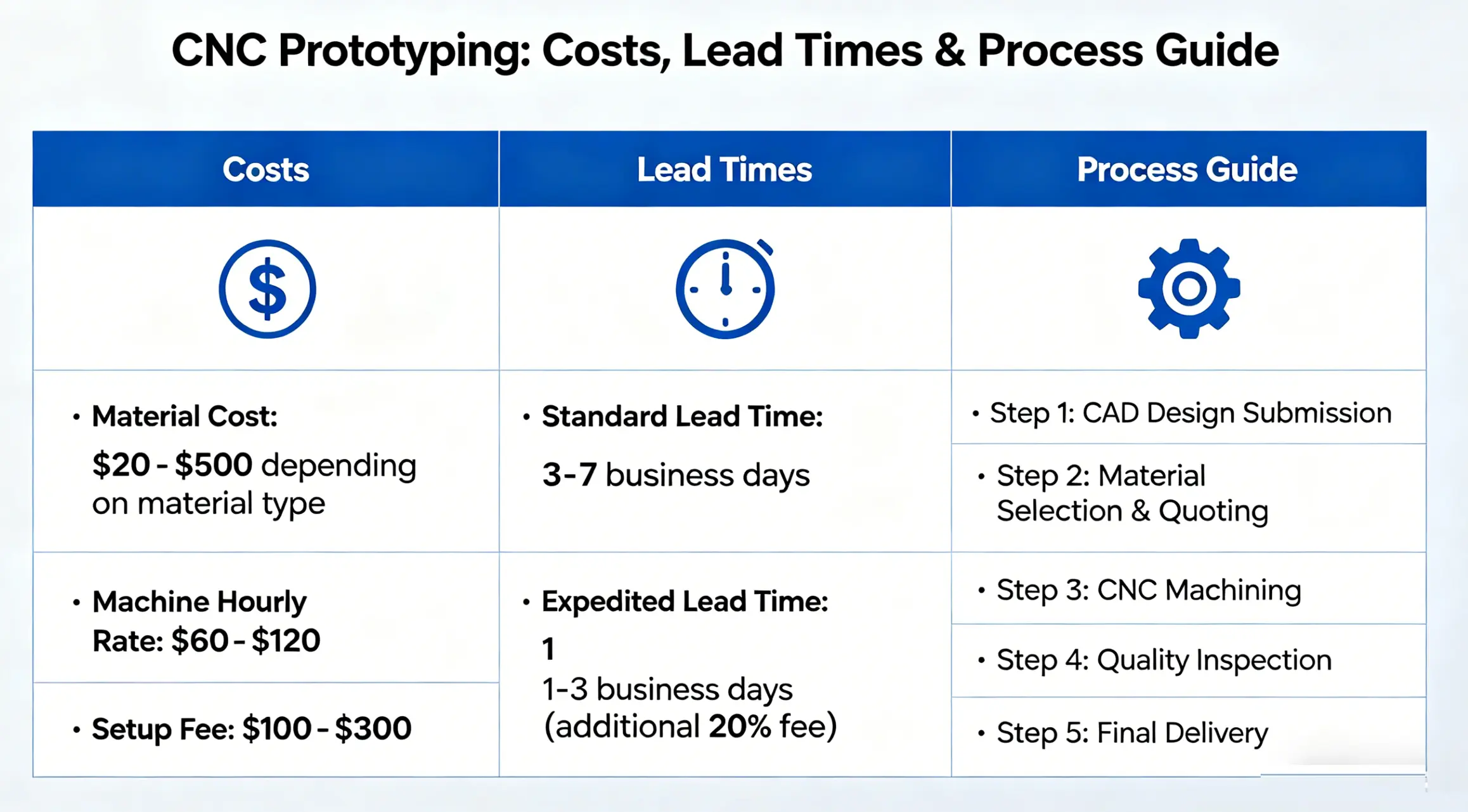
A simple aluminum bracket (3 in. x 2 in. x 1 in., 2 setups, ±0.005 in.) costs $50-100 for 1 piece. The same bracket at 10 pieces drops to $25-50 each because the programming and setup time ($80-150) is spread across more units.
A complex stainless steel housing (6 in. x 4 in. x 3 in., 4 setups, ±0.001 in., tapped holes, O-ring grooves) costs $300-800 for 1 piece. At 10 pieces: $150-400 each.
A titanium aerospace fitting (5-axis, ±0.0005 in., CMM inspection, material cert) costs $500-2,000 for 1 piece. Titanium material cost alone can be $50-200 for the billet.
The pricing insight most engineers miss: CNC prototype cost is dominated by programming and setup time (typically $100-300 per setup), not by machining time. A part that takes 15 minutes to machine but requires 3 setups costs more than a part that takes 45 minutes to machine in 1 setup. Designing for fewer setups directly reduces prototype cost.
What Is the Prototype-to-Production Trap (and How to Avoid It)?
The prototype-to-production trap is when a design is validated in prototype form but cannot be manufactured economically at production volumes. It happens in two directions:
Trap 1: Prototype features that don't scale.
A CNC prototype can produce features that are prohibitively expensive in production. Example: a housing with 12 tapped holes, each requiring a manual tap change on the CNC machine. For 5 prototypes, this adds 10 minutes of cycle time and $20 per part. For 5,000 production parts, it adds $100,000 in cumulative labor. The solution: use thread mills instead of taps (one tool machines all thread sizes), or consider self-tapping screws that eliminate threading entirely.
Trap 2: 3D-printed prototypes that can't be machined.
A 3D-printed prototype validates geometry that includes internal channels, zero-radius internal corners, and variable wall thickness that CNC machining cannot produce. The design is "locked" based on 3D-printing test results, then sent for CNC production quoting. The quote comes back with 15 DFM issues. Six months of development time is partially wasted.
How to avoid both traps:
1. Get DFM feedback from your CNC supplier at Stage 1, not Stage 3. Upload your CAD before you finalize the design. A 5-minute DFM review catches the problems that cost $50,000 to fix later.
2. Design for the production process from the start. Add CNC-compatible internal radii (minimum = tool radius, typically 0.060 in. for a 0.125 in. end mill). Keep wall thickness above 0.040 in. for metals, 0.060 in. for plastics. Avoid features that require special tooling.
3. Prototype in the production material and process. If the production part will be CNC machined from 7075-T6, prototype in 7075-T6 on a CNC machine. If production is injection molding, CNC machine the prototype from the same resin family (not from a different material on a 3D printer).
How Fast Can CNC Prototypes Be Delivered?
Lead times depend on complexity, material availability, and the supplier's capacity.
Expedited (1-3 business days): Simple geometry in common materials (6061 aluminum, Delrin, ABS). 1-2 setups. Standard tolerance. The supplier needs stock material on hand and open machine capacity.
Standard (3-7 business days): Most CNC prototypes fall here. Moderate complexity, 2-4 setups, precision tolerance on critical features. CMM inspection if required.
Extended (7-15 business days): Complex 5-axis parts, exotic materials (titanium, Inconel, PEEK), tight tolerances requiring grinding or honing, or parts needing post-processing (anodize, plating, heat treatment).
The variable that most affects lead time isn't machining; it's material procurement. If the supplier doesn't stock your alloy in the size you need, adding 3-5 days for material sourcing is common. Specifying a standard billet size (round bar, flat plate in common thicknesses) instead of a custom size can shave days off the timeline.
FlagShip's CNC machining services deliver prototypes in as fast as 1 business day for expedited aluminum parts, with standard lead times of 3-7 days across 160+ materials. Upload your CAD file for instant DFM feedback and a quote that reflects your actual prototype requirements, not a worst-case estimate.
Frequently Asked Questions
What is CNC prototyping?
CNC prototyping is the production of prototype parts by machining them from solid material billets using computer-controlled mills and lathes. Unlike 3D printing, CNC prototyping uses the same materials, processes, and tolerances as production manufacturing, making it ideal for functional testing, fit validation, and regulatory submissions where production-representative parts are required.
How much does a CNC prototype cost?
Simple aluminum parts: $50-100 per piece. Complex multi-setup parts in engineering materials: $300-2,000. Titanium or Inconel aerospace prototypes: $500-5,000+. Cost is dominated by programming and setup time, not machining time. Ordering 5-10 prototypes instead of 1 reduces per-unit cost by 40-60% because setup is amortized.
When should I choose CNC prototyping over 3D printing?
Choose CNC when you need real material properties for functional testing, tolerances below ±0.005 in. for fit checks, surface finish that matches production, or parts for regulatory submissions. Choose 3D printing for concept models, ergonomic testing, organic geometries with internal channels, and rapid visual iteration where material properties don't matter.
How fast can CNC prototypes be delivered?
Expedited: 1-3 business days for simple aluminum or Delrin parts. Standard: 3-7 business days for most prototypes. Complex parts with exotic materials or tight tolerances: 7-15 business days. Material availability is often the biggest lead time variable, not machining.
What materials can be CNC prototyped?
Any machinable material: aluminum alloys (6061, 7075), stainless steels (303, 304, 316L, 17-4 PH), carbon steels (1018, 4140), titanium (Grade 2, Ti-6Al-4V), copper, brass, bronze, and engineering plastics (PEEK, Delrin, nylon, polycarbonate, ABS, PTFE, UHMW). Over 160 metals and plastics are available for CNC prototyping.
What is the prototype-to-production trap?
It's when a design validated in prototype form cannot be manufactured economically at production volumes. This happens when prototype features don't scale (manual operations acceptable for 5 parts but prohibitive for 5,000), or when 3D-printed prototypes validate geometry that CNC machines can't produce. The solution: get DFM feedback from your production supplier before finalizing the design.
Can CNC prototypes be used for regulatory testing?
Yes, and for many applications they must be. Medical device V&V testing (per ISO 13485), aerospace qualification (per AS9100D), and automotive PPAP submissions require prototypes manufactured under controlled conditions with material traceability. CNC prototypes from certified suppliers meet these requirements; 3D-printed prototypes from desktop machines generally do not.
How many prototypes should I order?
For functional testing: 3-5 parts minimum (enough for destructive testing, fit checks, and a spare). For pre-production validation: 10-20 parts to establish process capability (Cpk data). For bridge production: 50-500 parts to serve initial customers while production tooling is being built. The per-unit cost drops significantly at each quantity tier.
 Sophia
Published Date: 2026/4/24
Sophia
Published Date: 2026/4/24