Plastic remains one of the most popular materials used in creating a large number of consumer products. The potential uses of this material continue to expand into different industries. Likewise, we can’t ignore the expansion in the number of techniques for this material. Therefore, the need for this compression molding vs injection molding comparison.
Molding is one of the commonest manufacturing processing involving materials like plastic, rubber, and similar polymers. However, it is essential to note that not all molding processes are the same. For instance, injection and compression molding involve contrasting methods. Both of these techniques have their unique features and benefits.
In most cases, the specifications of an application often determine what type of process is best for the product. So, what is the difference between compression vs injection molding? Let’s dive right into it!
What is Injection Molding?
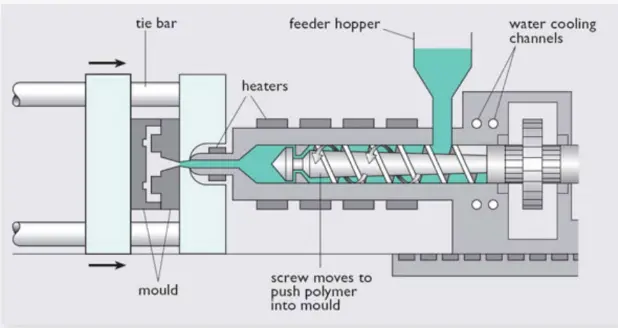
Injection molding is a process that involves the use of an ‘injection’ technology. The term “injection molding” is due to the procedure which generally involves injecting the raw material into the mold cavity.
During the injection molding process, the material is fed into the hopper by a screw. The heating process follows, and then injection into the mold cavity. The heated material cools and sets in the shape of the mold cavity.
This method offers many benefits in terms of production. It is the best choice for creating complex and intricate parts while also working well with large production runs. If you want consistency, accuracy, and versatility in your work, then injection molding is your best pick.
Advantages of Injection Molding
Some of the advantages of injection molding over compression molding include the following:
Efficient and fast production of uniform components
Ability to mold in tamper evidence features
Enhances versatility and customization
Low production costs
Solid and durable final products
Supports complex mold designs
Tolerates a wide range of materials
Disadvantages of Injection Molding
Here are a few cons of injection molding that you need to take note of:
High tooling cost
Small numbers of productions are usually costly
Tip: We also have an article that introduces injection molding defects and causes, and how to solve them.
Applications of Injection Molding
Injection molding is suitable for a wide range of applications due to its versatility. It helps to create everything ranging from intricate components to appliances. The application of injection molding in automotive parts production is now also widespread.
Some of its applications include:
Medical devices and dental parts
Automotive and aerospace components
Food and beverage packaging
Avionic components
Engineering prototypes
Cable assemblies
Window and door components
What is Compression Molding?
Generally, compression molding is defined by the application of heat and pressure. While this is similar to injection molding, the procedure is quite different.
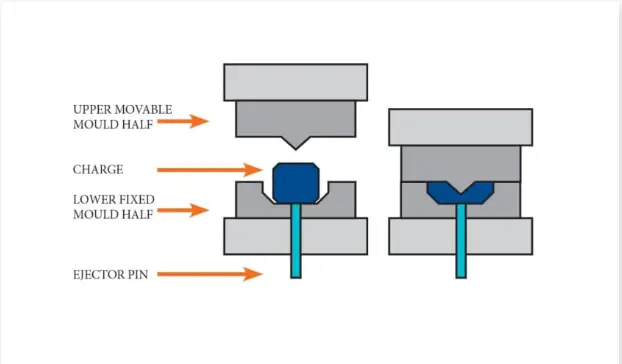
During compression molding, manufacturers place the raw material in the mold cavity where the heating occurs. After this, the operator inserts the plug into the top of the cavity to seal it. The plugs also help to apply pressure on the mold cavity further.
The heat and pressure work together to cure the raw material inside the mold cavity, leading to a new component. So, unlike injection molding, compression molding does not fill cavities with melted plastic materials. Instead, it involves placing the material into an already heated cavity.
Advantages of Compression Molding
Some of the advantages of compression molding include the following:
Ease of maintaining mold tooling
Low initial tooling costs and investment
Enables more efficient color changeovers
It preserves the mechanical and chemical properties of materials
Ensures better visual appearance by avoiding gate vestige
Disadvantages of Compression Molding
It would help if you keep the following downsides of compression molding in mind:
It may be slightly less consistent than injection molding
Not well suited for complex parts or large production runs
Products may show odd parting lines
Secondary machining may be required after compression molding
Reduced molding depth
Applications of Compression Molding
Compression molding gives strong and durable products. Thus, many industries tend to employ this technique for their applications. Some of the typical applications of compression molding include:
Automotive parts
Body armor
Circuit breakers
Plastic dinnerware
Electrical and electronic components
Compression Molding vs Injection Molding: Common Traits and Characteristics
While compression and injection molding are distinct techniques, they come with certain similarities. Both processes involve the molding of plastic materials. Thus, we would expect some common features. Let’s explore these common characteristics
Custom Color
Both injection and molding processes enable the creation of custom-colored plastic resins for manufacturing custom parts. Some applications require parts to come in specific colors for aesthetic purposes and to bring the product alive. These processes allow the use of pre-mixed colors for manufacturing purposes.
They also support masterbatch colors involving mixing with uncolored plastics. In this case, you get up to 2% color by volume. Another popular method involving injection and compression molding is solvent coloring. This process involves mixing pigmented oil with a solvent before spraying over uncolored pellets. Coating here is done prior to injection.
Finally, they also support dry pigment mixing. Here, the operator mixes the plastic resins with dry pigment powder in the hopper. In some cases, there may be a need to dry the pellets first before adding the resin. Hence, both injection and compression molding methods enable you to use your desired color regardless of your application.
Low Labor Costs
Both injection molding and compression molding technologies are very common. Asides from being common, these processes are relatively straightforward. Therefore, operators only require basic technical know-how to complete the processes.
Moreover, both processes support automation. Machines and robotics perform most of the process. This automation ensures a reduction in overall injection molding costs. Since only one operator monitors the operation of the machines, labor costs reduce significantly.
Reduced Part Costs
Tooling for both processes requires less infrastructure. They usually do not require any additional molding features asides from the cavity features themselves. Molding tools can come from different materials, including aluminum and low-cost steel grades. This generally reduces tooling costs while using high-quality materials.
Furthermore, molds tend to last longer in both processes. Therefore, reuse is possible with longer cycle times and multiple part production in the same cycle. Reduced tooling and labor costs combine to make both injection and compression molding cost-effective. At the end of production, components are usually affordable, depending on their complexities.
 Tony Chow
Published Date: 2026/1/27
Tony Chow
Published Date: 2026/1/27